



Published on 25 July 2026
By Harry Covert, corporate event magician and mentalist
How Can You Make a Corporate Seminar More Engaging?
The venue has been booked, the speakers confirmed and the presentations carefully prepared. Yet after several talks, attention begins to drift, phones appear and most conversations take place during the breaks. The programme is rich, but participants do not always feel genuinely involved.
The problem does not necessarily come from the quality of the speakers, the content or the budget. Disengagement often results from an accumulation of top-down sequences, uniform pacing, a lack of participation or poorly planned transitions.
An engaging seminar does not attempt to entertain employees every minute. It alternates different forms of attention, gives every sequence a clear purpose and allows participants to genuinely influence certain moments.
For more than sixteen years, Harry Covert has performed at seminars, conventions, cocktail receptions and corporate events. His experience of mentalism, close-up magic and participatory formats allows him to directly observe when attention increases, begins to drift or turns into interaction.
To make a seminar more engaging, it is important to define the expected role of participants, alternate different formats, manage transitions and create several opportunities for choice, reaction and conversation.
In a nutshell : A seminar becomes engaging when it alternates content, breathing space and participation, gives employees a genuine role and connects every sequence to a clear objective. Close-up magic and participatory mentalism can re-engage attention, create interactions and bring the group together, provided that they respect the event’s rhythm, voluntary participation and the company’s message.
What Really Makes a Seminar Engaging?
An engaging seminar is a corporate event in which participants do more than receive information: they understand the objective, contribute at their own level, exchange ideas and take part in a collective experience.
Engagement Is Not Limited to Raising a Hand
A participant can be engaged when they listen actively, ask a question, speak with someone from another department, creating this type of connection deserves to be explored in its own right, make a decision, contribute to an experience or continue a conversation after the sequence has ended.
The Seven Steps to Make a Seminar More Engaging
A precise objective : Every sequence should serve an identifiable result.
Varied pacing : Listening, conversation and participation formats should alternate.
Carefully managed transitions : Changes between sequences should not create uncertainty or unnecessary downtime.
A genuine role for participants : Employees should be able to choose, react or contribute.
A collective emotion : Surprise, curiosity, laughter or pride strengthen the shared experience.
Consistent personalisation : The content should genuinely belong to the company and the seminar.
A lasting memory after the event : Participants should be able to identify and retell a specific moment.
Engagement Does Not Mean Constant Activity
An engaging programme should also include periods of listening, moments for reflection, breaks and informal conversations without entertainment.
Key takeaway : An engaging seminar does not fill every minute. It gives meaning to every change of pace and provides participants with a clearly defined role.
Why Do Participants Disengage During a Seminar?
Participants disengage when formats become repetitive, messages accumulate and no action allows them to become active participants in the day again.
Too Many Presentations Create Uniform Attention
Several consecutive speeches, slides overloaded with information, speakers all using the same format or the absence of any summary create progressive fatigue. There is no need to refer to a supposedly universal attention span to explain it.
A Content-Rich Programme Can Still Lack Rhythm
A programme can contain a great deal of information while remaining monotonous.
Variety should involve the number of people speaking, the audience’s position, the level of participation, group sizes and the alternation between content and experience.
A Disconnected Activity Does Not Solve the Problem
Adding a game or show is not enough if it appears without a transition, does not suit the audience, interrupts an important moment or requires everyone to participate.
Participants Do Not Always Understand What Is Expected of Them
Before every sequence, participants should know whether they are expected to listen, reflect, answer, choose, discuss or simply enjoy the moment.
In summary, a primarily top-down seminar consists of consecutive presentations delivered to a passive audience, with few changes of pace and a memory centred on the content.
A participatory seminar alternates between content and interaction, offers several levels of participation, prepares its transitions and leaves participants with a memory connected to something they genuinely experienced.
Key takeaway : Disengagement does not result solely from a lack of entertainment. It often appears when participants no longer understand their role or the connection between the different sequences.
How Can a Seminar Be Structured to Maintain Attention?
To maintain attention, a seminar should alternate different forms of involvement: listening, reflection, conversation, movement, surprise and breathing space. No single format should dominate the entire day.
Create a Progression Rather Than a Succession of Activities
Every sequence should prepare the next: welcome and initial conversations, a clear opening, the first content block, a moment for reactions, a shorter second block, an active break, a workshop, feedback, a collective highlight, the conclusion and an informal social moment.
From the moment participants arrive, mentalism can also act as a conversation starter between employees who rarely have the opportunity to speak to one another.
Change the Mode of Attention
A useful change of pace can involve moving from a presentation to a question, from collective listening to a small-group discussion, from an intellectual sequence to an emotional experience, or from a speech to a decision made by the audience.
Use Transitions as Genuine Sequences
The arrival of participants, the return from a break, the transition between lunch and the afternoon, the wait before a presentation or the move towards the cocktail reception are all sensitive moments.
Mobile entertainment can accompany some of these transitions without interrupting the programme.
Allow for Flexibility
The event schedule should make it possible to shorten a presentation, adapt a transition, respect an important conversation or allow an unexpected collective reaction to develop.
Key takeaway : Managing the rhythm does not mean constantly accelerating. It means regularly changing the way participants use their attention.
How Can Employees Become Active Participants Without Feeling Uncomfortable?
Employees become active participants when they have a genuine choice and an appropriate role, without being required to expose themselves in front of their colleagues or managers.
Offer Several Levels of Participation
A participant may observe, answer from their place, vote, write down an idea, make a choice, participate with a colleague, lend an object or contribute to a collective decision.
Keep Participation Voluntary
Premium entertainment excludes insistence, mockery, deliberately setting someone up to fail, using sensitive information, jokes about hierarchy and any requirement to step onto a stage.
Anticipate the Characteristics of the Audience
The organiser and performer should understand the number of participants, languages spoken, level of formality, hierarchical relationships, variety of roles and any cultural differences.
Make the Participant Look Good
The experience should allow participants to contribute to the success of the moment, remain in control, never appear ridiculous and be associated with a positive reaction from the group.
Harry explores this principle further in Why Your Guests Become the Show.
Respectful participation gives employees a role within the experience while allowing them to observe, contribute or decline without having to justify themselves.
Key takeaway : Engagement is not measured by the number of people brought onto a stage. It is measured by the sense of freedom, usefulness and comfort felt by the group.
How Do Close-Up Magic and Mentalism Make a Seminar More Engaging?
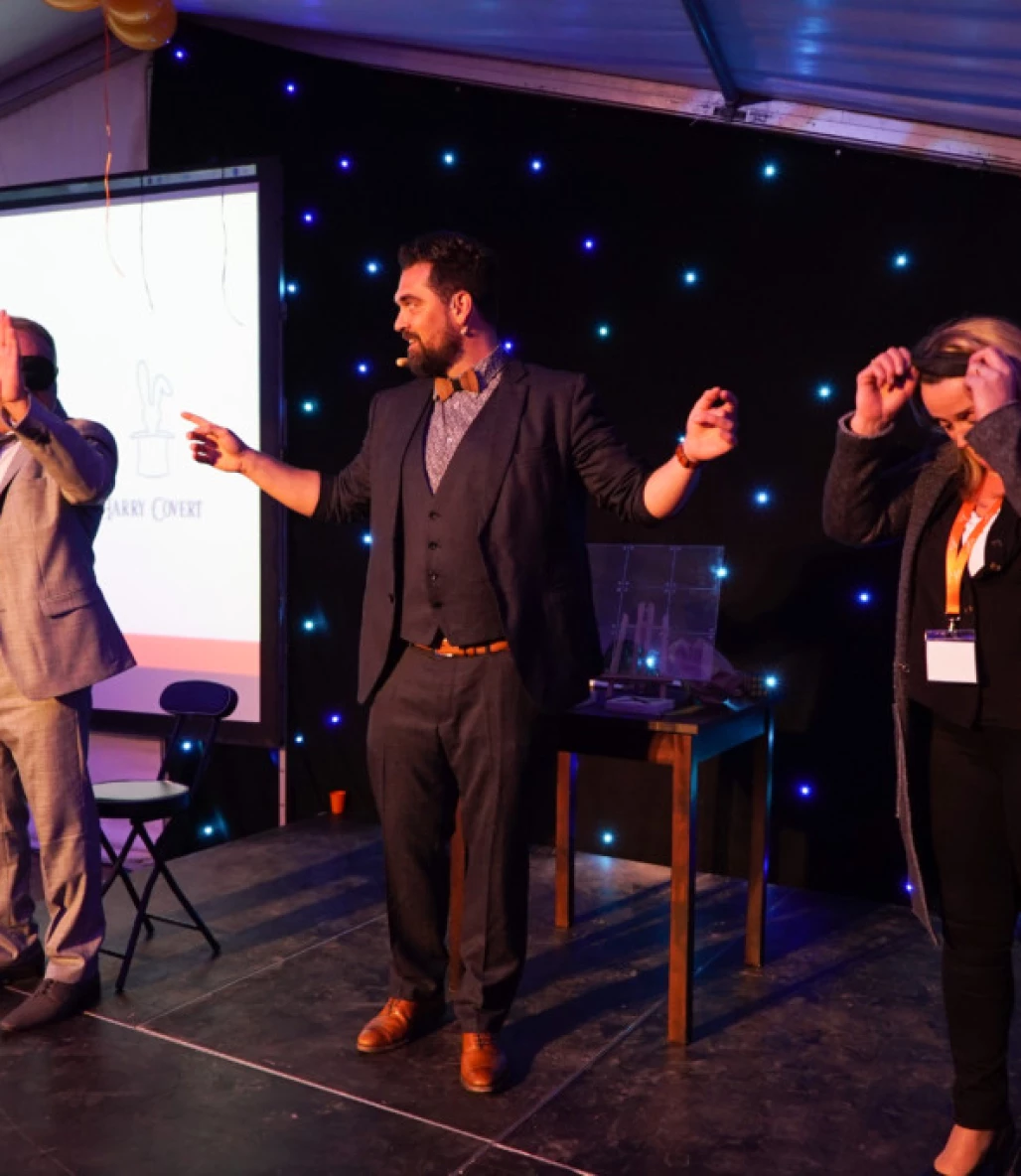
Close-up magic and participatory mentalism can increase seminar engagement because they immediately change the audience’s role. Employees’ decisions, intuitions and reactions become the material of the experience.
An important distinction should be made from the outset: this article does not discuss magic as a team-building activity, that subject is explored separately, but as one of the seven engagement tools used throughout a seminar.
Close-Up Magic Brings Informal Moments and Transitions to Life
Close-up magic is performed near the participants, generally in small groups during the welcome, a break, cocktail reception or dinner.
It can be incorporated during the welcome, an extended break, between the workshops and dinner or from table to table. No stage is required, and the short sequences can be adapted to each group while respecting the pace of the service.
Mentalism Creates a Collective Highlight
Mentalism can involve individual choices, a collective decision, an intuition, a prediction or several employees positioned in different parts of the room.
The audience no longer simply watches the performer. Participants follow one another’s choices and attempt to understand how their decisions could possibly come together.
The Experience Can Support the Message Without Becoming Promotional
The seminar theme, a company value, an ambition, a figure or part of the company’s history can be integrated into an experience or revelation.
This personalisation should remain subtle. If it becomes too commercial, it reduces the surprise and turns the experience into another presentation.
Two Real-World Examples
During Mobalpa’s annual convention at the Royal Resort in Évian, Harry Covert combined close-up magic with participatory mentalism. The performance was positioned between presentations, the cocktail reception and dinner to bring employees together without disrupting the event schedule.
For a BNI group in Annecy, Harry appeared as a mystery guest before presenting a twenty-minute interactive show, followed by close-up magic during lunch. The format was adapted to the programme and the different levels of attention throughout the meeting.
Key takeaway : Magic creates a break in attention. Mentalism gives employees’ decisions a genuine role. Combining the two creates a collective moment without turning the seminar into a simple show.
When Should Entertainment Be Integrated and How Can Engagement Be Measured?
Entertainment should be scheduled when it responds to a specific need: welcoming participants, re-engaging attention, creating connections, supporting a transition or concluding the seminar.
During the Welcome
Facilitate the first conversations and gradually mix different teams through close-up magic or very short experiences moving from group to group.
After a Dense Block of Content
Create a change of pace and move the audience from a listening position to an active one through a short collective sequence or a mentalism experience involving several participants.
After a Dense Block of Content
Create a change of pace and move the audience from a listening position to an active one through a short collective sequence or a mentalism experience involving several participants.
During the Cocktail Reception or Dinner
Extend conversations and bring different departments closer together. Encouraging conversations during the seminar cocktail reception follows the same logic, moving from table to table.
At the End of the Seminar
Bring all participants together and leave them with a shared emotion through a participatory show or a personalised collective prediction.
Moments to Avoid
Do not perform during an important speech, while a course is being served, when a strategic discussion is taking place or simply to fill an unexpected delay without preparation.
Engagement Indicators to Observe
Voluntary participation, the quality of the reactions, conversations between departments, discussions that continue after the sequence and participants’ ability to restate the message are more useful than an undocumented engagement percentage.
Key takeaway : Successful entertainment is not simply appreciated. It fulfils an identifiable purpose within the programme and produces observable reactions after it has ended.
How Can the Programme Be Turned into a Collective Experience?
An engaging seminar does not depend on the number of activities added to the programme. It depends on the consistency between the objectives, pacing, content and the role given to participants.
A clear intention, varied formats, prepared transitions, voluntary participation, a shared emotion, useful personalisation and the measurement of reactions: these seven approaches, far more than a single spectacular activity, create an event that participants will remember.
Harry Covert’s role is not to replace the conferences, workshops or work of the event agency. It is to create the breaks in attention, interactions and highlights that allow participants to experience the seminar rather than simply follow its programme.
Through close-up magic and mentalism, employees’ choices, intuitions and reactions directly influence the experience. Guests are no longer simply seated in front of entertainment: they become part of it.
The seminar therefore retains its professional objectives while giving teams a shared memory and something they will want to talk about when they return to work.
FAQ — Your Questions About Seminar Engagement
How Can You Make a Corporate Seminar More Engaging?
Alternate presentations, small-group discussions, breathing space and collective experiences.
Every sequence should have a clear purpose. Participants should also have a genuine role: asking a question, making a decision or contributing to an experience without being required to place themselves in the spotlight.
Which Entertainment Should You Choose for a Seminar?
The format depends on the moment and the objective.
Close-up magic is suitable for the welcome, breaks, cocktail reception and dinner. A collective mentalism sequence can re-engage attention after presentations or create a highlight at the end.
The entertainment should be integrated into the programme rather than functioning as an independent interlude.
How Can You Prevent Employees from Disengaging?
Limit long, repetitive sequences, prioritise the key messages and regularly change the way participants use their attention.
A question, conversation, change of space or short experience may be enough. The objective is not to constantly accelerate, but to alternate between concentration, participation and breathing space.
What Is the Difference Between an Engaging Seminar and Team Building?
Team building generally refers to a specific activity dedicated to relationships or team cohesion.
An engaging seminar concerns the entire programme: conferences, workshops, transitions, breaks and the evening event. A team-building activity can contribute, but it is not enough to make the entire day engaging.
Is Mentalism Suitable for a Corporate Seminar?
Yes, when it is adapted to the audience and level of formality.
Mentalism can involve employees’ decisions, re-engage attention and create a collective highlight. Participants must remain free to choose their level of involvement, and the performance should never rely on humiliation or the use of sensitive information.
When Should a Magician and Mentalist Perform?
Close-up magic can accompany the welcome, a break, cocktail reception or dinner.
A collective performance can take place after a dense block of content, before the conclusion or during the evening. The right moment depends on the event schedule and the intended purpose: creating connections, re-engaging attention or bringing the group together.
How Can the Entertainment Be Personalised Around the Seminar?
The theme, a value, a product, an ambition or a message can be integrated into an experience or revelation.
This personalisation should remain subtle. It works best when it extends the seminar content rather than turning the show into a commercial presentation.
How Can Employees Participate Without Feeling Uncomfortable?
Offer several levels of participation: observing, answering from one’s place, making a choice or joining the performer.
Refusals should be accepted immediately. The performer must also consider the hierarchy, languages spoken, company culture and level of formality.
How Can Engagement Be Measured After the Seminar?
The organiser can observe the questions asked, conversations between teams, voluntary participation and discussions that continue after the entertainment.
Post-event surveys can ask which moment participants remember, which message they understood and which sequence facilitated conversations. These indicators are more useful than a general rating alone.
What If Your Employees Genuinely Experienced Your Seminar?
A seminar does not become engaging because its programme is full. It becomes engaging when every sequence gives participants a reason to listen, react, exchange ideas or contribute.
Harry Covert, magician and mentalist for corporate seminars, designs close-up magic and mentalism performances for seminars, conventions, corporate away days and company events.
Every performance is prepared according to your objectives, the employees’ profiles, the event schedule, venue, number of participants, level of formality and desired degree of participation.
From close-up magic during the welcome or cocktail reception to a collective mentalism highlight, the objective remains the same: to create an elegant break in attention and give participants a genuine role.
Your employees no longer simply watch the entertainment: their choices, reactions and conversations become the material of the experience.


