


Published on 25 July 2026
By Harry Covert, magician and mentalist, creator of participatory experiences
How Can You Create Authentic Connections Between Your Guests?
An event can be perfectly organised, held in a remarkable venue, include an excellent dinner and bring together carefully selected guests without necessarily creating genuine connections. Conversations may remain polite, predictable and limited to professional roles. Everyone exchanges a few words before returning to the people they already know.
Bringing people together in the same room creates an opportunity. It does not automatically create a relationship.
Guests may be afraid of interrupting, familiar groups form again, hierarchical differences limit spontaneity and conversations quickly become transactional. One simple ingredient is often missing: a genuinely shared experience.
An authentic connection begins when someone is no longer reduced to their job title, company or role at the event. It appears when several guests focus their attention on the same experience, react together and discover one another from a different perspective.
By performing at the heart of cocktail receptions, client events, conventions and seminars, Harry Covert directly observes the moments when a group opens up, curiosity begins to circulate and a collective reaction transforms the dynamic between participants.
To create authentic connections, guests should be offered a shared, voluntary and positive experience that allows them to react together before they even have to discuss their roles or professional objectives.
In a nutshell : An authentic connection between guests begins when they share an experience that creates mutual attention, emotion and free-flowing conversation without forced interaction. To encourage this, the event must provide a reassuring environment, open groups and a shared conversation starter. Close-up magic and participatory mentalism can fulfil this role by turning guests’ choices and reactions into a collective experience.
What Is an Authentic Connection Between Guests?
An authentic connection is an interaction in which two or more guests give one another genuine attention, share an emotion or experience, and continue the conversation without being required to do so by the programme.
A Conversation Is Not Always a Connection
Many participants immediately join their colleagues, team, the people they arrived with or a group whose social codes feel familiar. This behaviour is not a flaw. It is a natural way of reducing social uncertainty.
Starting a Conversation Requires Effort
Contact is the moment when two people introduce themselves. An exchange takes place when they share some information. A connection appears when they develop mutual attention and curiosity.
A relationship implies that the connection continues after the event, a result that no form of entertainment can guarantee on its own.
The Signs of an Authentic Connection
An authentic connection can be recognised when people genuinely listen to one another, when the conversation is no longer based solely on professional roles, when participants share a spontaneous reaction, when everyone contributes a personal interpretation, when the group remains together after the experience has ended or when guests speak to one another again later in the evening.
Authenticity Does Not Mean Forced Intimacy
There is no need to ask participants to share personal information, describe a difficulty or take part in a compulsory group exercise. A connection can emerge through curiosity, laughter, uncertainty or a shared surprise.
Key takeaway : An authentic connection is not measured by the depth of personal disclosure. It appears when guests briefly stop acting only through their professional roles and share genuine attention.
Why Don’t Events Automatically Create Connections?
Events provide opportunities to meet, but several social, hierarchical and organisational barriers can prevent participants from moving beyond superficial exchanges.
Guests Look for Security First
When they arrive, participants naturally approach their colleagues, the people they came with, their regular clients or groups whose social codes they understand. This behaviour is not a rejection of others. It reduces uncertainty.
Professional Roles Can Limit Spontaneity
During a client event or convention, everyone can remain confined within their official identity: executive, supplier, buyer, employee, prospect or brand representative.
The fear of being judged or making a social mistake can limit humour, curiosity and spontaneous reactions.
Overly Explicit Networking Can Become Transactional
When the objective of meeting new people is emphasised too strongly, conversations can be reduced to a brief introduction, a business card, the search for an opportunity or a question about someone’s role.
These exchanges are useful, but they do not necessarily create a personal connection. This is precisely the issue explored in How Mentalism Transforms Corporate Networking, which focuses specifically on this stage.
Some Activities Can Increase the Distance Between Guests
An activity can have the opposite effect when it imposes participation, treats the audience like children, places certain individuals in uncomfortable situations, requires lengthy explanations, creates excessive competition or focuses all the attention on the performer.
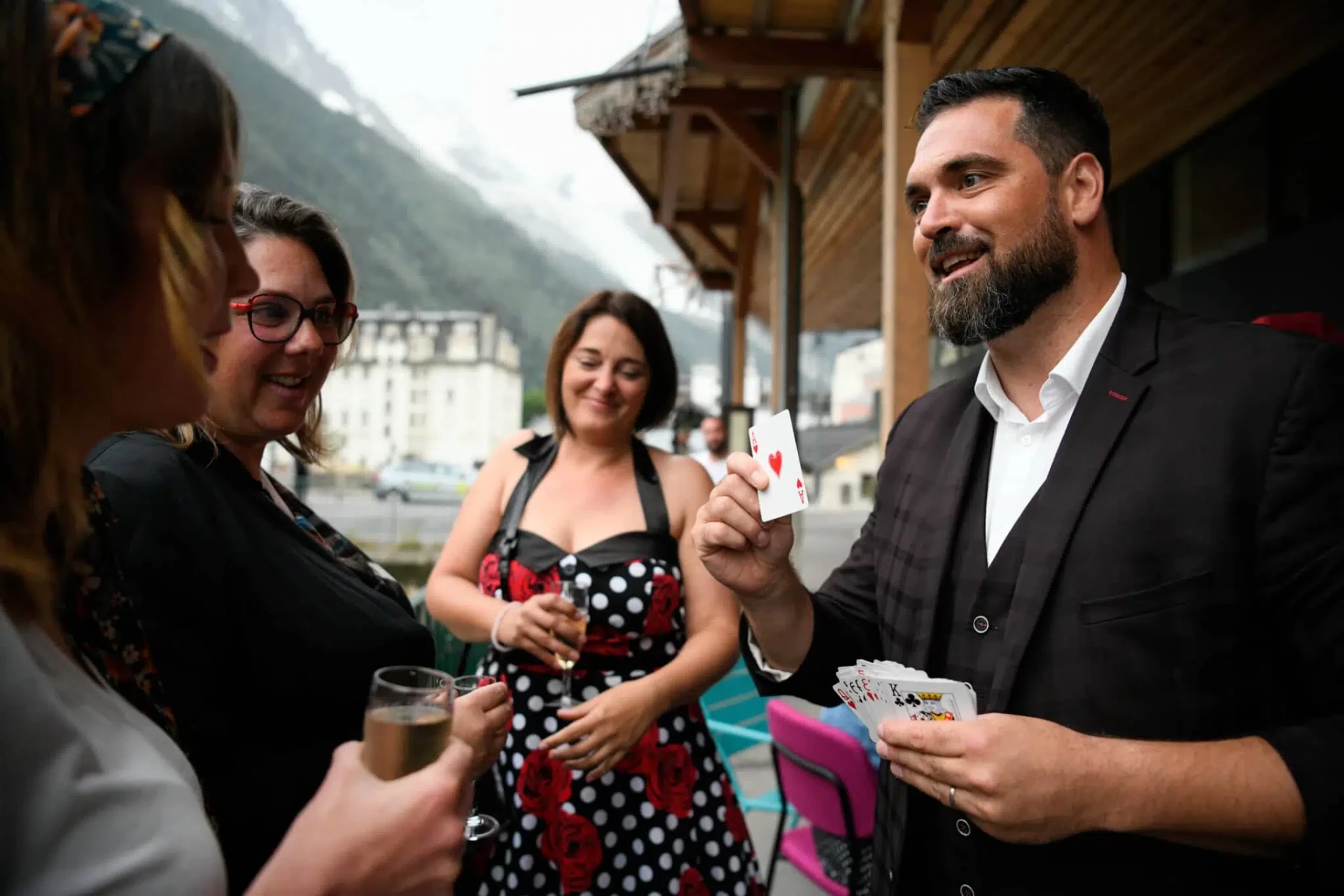
When someone hesitates to join a group, a visible close-up experience gives them a legitimate reason to move closer. They are not interrupting a private conversation: they are joining a moment shared by the group.
Key takeaway : A lack of connection does not necessarily indicate a lack of willingness. Guests primarily need an environment that reduces social risk and gives them a natural reason to approach one another.
Which Conditions Encourage More Natural Relationships?
Connections form more easily when guests feel free, respected and sufficiently secure to step outside their usual roles for a few moments.
Create a Sense of Social Safety
Participants should know that they will not be ridiculed, that they can decline to participate, that no sensitive information will be used, that their hierarchical position will be respected and that they are free to join or leave the group.
Encourage Small, Open Groups
Conversations are often more natural within groups of three to six people. These groups are easy to join, small enough to share the same experience and flexible enough to change throughout the evening.
Provide a Shared Topic That Is Not Solely Professional
The topic may come from the venue, an object, a tasting experience, a question, a magical experience, a prediction or a shared choice—something that allows guests to talk without immediately having to present their work or defend a professional interest.
Offer Several Levels of Participation
A guest may observe, move closer, react, answer from their place, make a simple choice, lend an object or contribute to a collective experience.
Before the event, a few questions help confirm the essentials: Are the groups easy to join? Does the noise level allow people to listen? Do guests have enough time to talk? Does the entertainment leave room for their reactions? Is participation voluntary? Have hierarchical differences been anticipated?
Key takeaway : Authentic connections rarely emerge through pressure. They develop when the setting makes curiosity, listening and participation simple and safe.
How Do Magic and Mentalism Create a Genuinely Shared Experience?
Close-up magic and mentalism can create connections because they redirect attention: guests do not simply watch the performer; they observe the choices, reactions and perceptions of the other participants.
Close-Up Magic Creates Immediate Proximity
Close-up magic is performed only a few inches away from the guests, generally in small groups during a cocktail reception, dinner or private reception.
It encourages relationships because the experience takes place at the heart of the group, several people witness the same phenomenon, a new guest can gradually move closer, and the conversation continues after the magician has left.
Mentalism Gives Meaning to Guests’ Decisions
Mentalism can be based on an intuition, a thought, a prediction, an individual choice, a collective decision or a connection between two people.
Guests no longer simply observe a result. They see how the decisions of the people around them contribute to the experience.
Attention Becomes Mutual
One person observes another guest’s choice, several participants become witnesses, everyone attempts to understand the perceptions of the others, attention circulates within the group and the revelation belongs collectively to the participants.
The emotional centre of the moment is therefore not Harry Covert alone. It exists between the guests.
Your Guests Become the Show
“Your guests become the show” does not mean that they have to perform or step onto a stage. It means that their decisions, reactions and relationships become the most important material within the experience, a principle Harry explores in Why Your Guests Become the Show.
Knowing When to Leave the Group
The magician and mentalist’s role also involves assessing whether the group is available, choosing a suitable experience, concluding without extending the moment artificially, allowing guests to compare their perceptions and moving on when the conversation begins.
During a corporate event, two participants who barely know one another each make a decision. An unexpected connection appears between their choices. The other guests react, offer their own explanations and begin talking among themselves.
When Harry moves on to another group, the conversation continues without him. The experience has created a connection rather than simply occupied the guests’ attention.
A collective experience between business leaders and a team event featuring close-up magic illustrate this same dynamic in different settings.
Key takeaway : Magic creates surprise, but the connection appears when guests observe one another’s reactions, compare their perceptions and continue the experience together.
How Can This Approach Be Integrated into Different Corporate Events?
The format should be chosen according to the type of relationship sought, the profile of the participants, the venue layout and the moment within the programme.
For a Cocktail Reception or Client Event
Close-up magic in small groups, short sequences, fluid movement and an elegant tone reduce the distance between clients and partners while making it easier for guests arriving alone to join others. The article on encouraging conversations during a professional cocktail reception explores this format in greater detail.
For an Internal Seminar
Experiences involving several departments, collective choices and an alternation between small groups and shared moments help break down silos and create a shared emotion without imposing an HR exercise.
For a Convention
A collective sequence between two presentations, featuring a revelation that brings several decisions together, re-engages the audience’s attention and creates a common point of reference after a full day of content.
For a Product Launch
Subtle personalisation connected to a product feature or message can create continuity between the entertainment and the brand’s world.
Any personalisation that is too promotional should be avoided, as it risks turning the mentalism into a sales presentation.
For a Trade Show
Mentalism can create an initial interaction, attract several visitors and make it easier for the sales team to take over the conversation. However, it should not be presented as a guarantee of leads or revenue.
How Can the Quality of the Connections Be Assessed?
Concrete indicators can reveal the effects: groups that were initially separate begin to mix, conversations continue after the performance, participants return to the experience later or people reconnect after the event.
Key takeaway : The same experience is not suitable for every event. An authentic connection depends on the alignment between the audience, the format, the chosen moment and the proposed level of participation.
Why Place Relationships Between Guests at the Heart of the Event?
Guests may forget the details of a menu, the order of the speeches or the exact event design. They are more likely to remember someone they met, a shared reaction or a moment that allowed them to discover one another differently. This is precisely the subject of How to Create a Shared Memory at an Event.
Connections cannot be ordered into existence. They require a reassuring environment, voluntary participation, a shared experience that reduces distance and attention that circulates between participants rather than remaining focused on the performer.
Through both close-up magic and mentalism, Harry Covert designs experiences in which guests’ choices and reactions become the material of the moment.
His role is not to replace conversations, but to create the spark that makes them more natural, more personal and more memorable—a principle that informs his entire approach, from the ingredients of a memorable event to each individual performance.
Your guests no longer simply watch the entertainment. They experience something together, discover the reactions of the people around them and become the protagonists of a moment that belongs to them.
FAQ — Your Questions About Authentic Connections Between Guests
How Can You Connect Guests Who Do Not Know One Another?
Give them a simple and natural reason to focus their attention on the same thing. A shared experience, question or small-group activity reduces the difficulty of making the first contact.
Guests can begin by reacting together before discussing their work or professional objectives.
What Is the Difference Between an Exchange and an Authentic Connection?
An exchange involves sharing information. A connection involves mutual attention, genuine curiosity and often a shared emotion or experience.
Not every conversation needs to become profound, but an event can create the conditions that allow participants to move beyond predictable introductions.
Which Type of Entertainment Naturally Brings Guests Together?
Mobile, short and participatory entertainment is particularly suitable. Close-up magic and mentalism bring several people together around an experience that is immediately easy to understand.
They give participants a role without imposing a game, public presentation or activity that might make them uncomfortable.
Why Does Mentalism Encourage Connections?
Mentalism is based on guests’ choices, intuitions and perceptions. Participants observe one another’s reactions and become witnesses to the same revelation.
This experience gives them a neutral and shared topic that facilitates conversation between people with different prof
How Can Guests Participate Without Being Forced?
Several levels of involvement should be offered: observing, answering from one’s place, making a choice or participating more directly.
The performer must immediately accept a refusal, avoid sensitive information and never use humiliation. Freedom of participation is essential to the quality of the connection.
Is Close-Up Magic Suitable for VIP Guests?
Yes, provided that the performance is discreet, elegant and adapted to the level of formality.
The magician must know how to observe the groups, avoid interrupting an important conversation and favour experiences that make the guests look good. Confidentiality and respect for participants remain the priorities.
Can Authentic Connections Be Created During a Large Convention?
Yes. Small groups can be engaged during the welcome or breaks, before a collective experience provides the entire room with a shared point of reference.
The connection will not take the same form as during an intimate cocktail reception, but a shared emotion can bring participants closer together.
How Can the Quality of the Connections Be Measured?
It is possible to observe whether groups begin to mix, whether conversations continue after the entertainment and whether guests spontaneously refer to the moment again.
Post-event surveys and feedback from the organising team can complement these observations. It is preferable to avoid promising a precise relationship-building result.
What If Your Guests Discovered One Another Differently?
Creating authentic connections does not mean imposing a networking exercise or forcing participants to reveal personal information. It means offering them an experience that is intriguing, elegant and human enough to make them naturally want to react together.
Harry Covert, corporate event magician and mentalist, designs close-up magic and mentalism performances for cocktail receptions, client events, conventions, seminars, product launches and premium events.
Each performance is prepared according to the guests’ profiles, their existing relationships, the level of formality, the rhythm of the programme and the desired level of participation.
Guests are never reduced to the role of spectators or designated volunteers. Their choices, reactions and the relationships that form between them become the true material of the experience.
Your guests become the show and the show becomes a meeting point.


